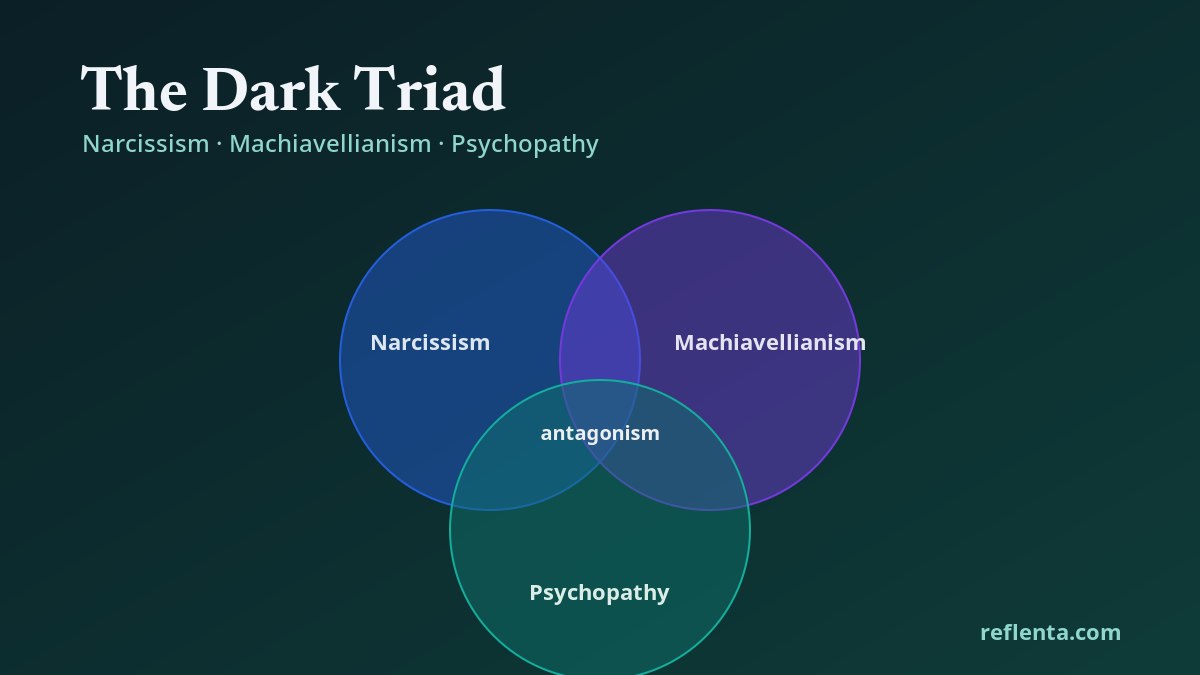
Think of someone who seems charming but always has an agenda. Or a colleague who craves praise but crumbles under criticism. These behaviours often trace back to three specific personality traits that psychologists group together. The term Dark Triad was coined by Delroy Paulhus and Kevin Williams in 2002 to describe narcissism, Machiavellianism, and psychopathy.
We call them dark because they share a common thread of antagonism. People high in these traits tend to be self-centred and manipulative. They often put their own interests above others. However, these are not clinical diagnoses. They are normal personality traits found on a continuum. Everyone has some degree of these traits; the difference lies in how strongly they are expressed.
The Shared Core of Antagonism
What links these three traits is a low level of agreeableness. This manifests as a willingness to manipulate, a callous attitude, and a focus on self-interest. While the core motivation is similar, the flavour of each trait is distinct. Narcissism centres on admiration. Machiavellianism focuses on strategy and control. Psychopathy is driven by impulsivity and fearlessness. Understanding these nuances helps you see how these traits play out in daily life.
Narcissism: The Need for Admiration
Narcissism is primarily about feeling special and seeking status. It has two main sides. The grandiose side involves confidence, entitlement, and a desire to be admired. The vulnerable side involves being easily stung by criticism and feeling insecure. This trait is not just about vanity; it is about how you regulate your self-worth through external validation.
You can explore your own tendencies with our free narcissism test (FFNI). This tool uses the Five-Factor Narcissism Inventory Super Short Form, which consists of 15 statements. It helps you identify whether you lean toward the grandiose or vulnerable side. Remember, a high score is a self-description, not a verdict on your character.
Machiavellianism: Strategic Self-Interest
Machiavellianism takes a more calculated approach to human relationships. Named after Niccolo Machiavelli, this trait is defined by a strategic and calculating mindset. People high in this trait are willing to manipulate others to achieve their goals. They often hold a cynical and guarded view of other people, assuming others are self-interested too.
Unlike the emotional reactivity of narcissism, Machiavellianism is cold and efficient. It is about control and long-term planning. You can check your strategic tendencies with our free Machiavellianism test (FFMI). This assessment uses the Five-Factor Machiavellianism Inventory Super Short Form with 15 statements. It highlights your comfort with manipulation and your view of human nature.
Psychopathy: Boldness and Impulsivity
Psychopathy in this context refers to a cluster of traits including boldness, risk-taking, and low empathy. It is characterised by callousness and a tendency to act on impulse. Unlike the calculated Machiavellian, the psychopathic trait is often about immediate gratification and fearlessness in the face of risk. It is not the same as clinical psychopathy or antisocial personality disorder.
You can assess these traits using our free psychopathy test (EPA). This test uses the Elemental Psychopathy Assessment Super Short Form, which includes 18 statements. It measures your level of boldness and emotional detachment. High scores are common and do not make you dangerous; they just indicate a specific way of processing risk and emotion.
How to Measure and Reflect
These traits are measured through self-report questionnaires. They are screening tools designed for self-reflection, not diagnosis. A high score simply means you identify with these statements more than others. It does not mean you have a disorder. Only a qualified professional can assess a clinical disorder. These scores are common in the general population.
The practical value lies in self-awareness. Recognising these tendencies is the first step. If these traits are costing you in relationships, you can work on them. Traits are not fixed; they can be reflected upon and adjusted. Use these tests to understand your baseline, then observe how you behave in real-world situations.
Not a Diagnosis, Just a Profile
It is crucial to remember that the Dark Triad describes normal personality variation. These are not medical conditions. You are not a narcissist or a psychopath because you scored high on a test. You are a person with certain tendencies. The goal is not to label yourself but to understand your social style. With this knowledge, you can approach relationships with more clarity and intention.