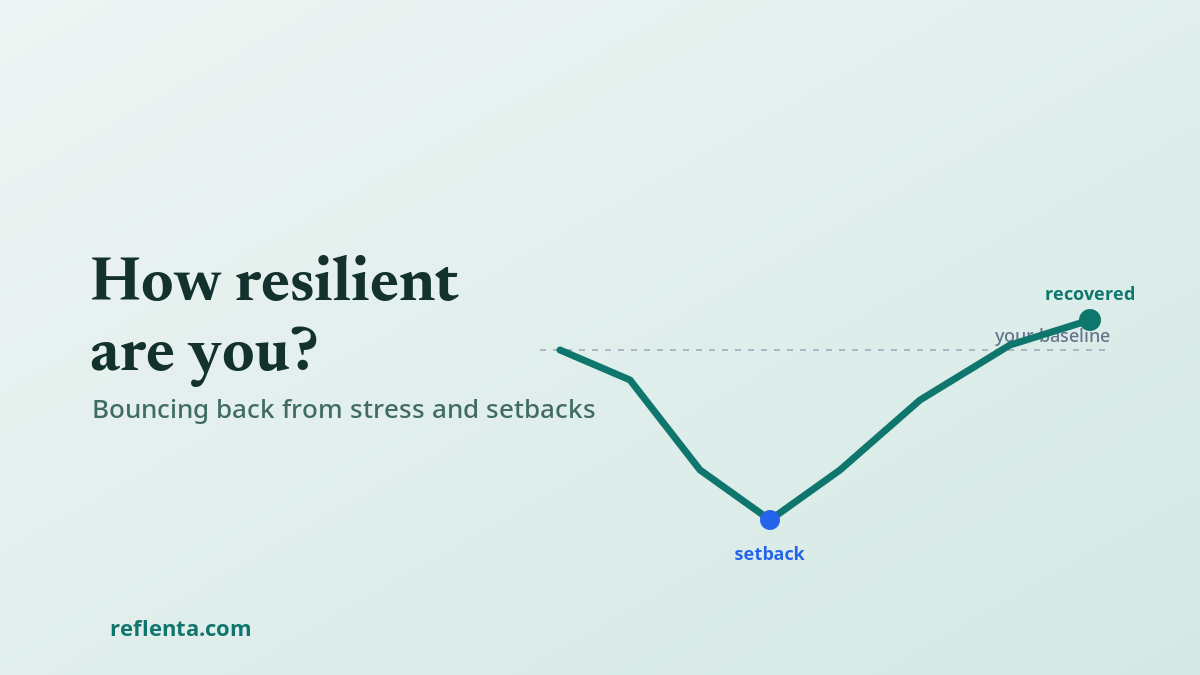
You have a big presentation on Tuesday. On Monday night, you lie awake worrying about every possible thing that could go wrong. Your heart races, your stomach turns, and you feel completely drained. Then, the presentation happens. It goes fine. By Wednesday morning, you are back to your normal self, ready to tackle the next task. That quick return to your baseline is resilience.
Many people confuse resilience with toughness. They think it means never feeling stressed or never struggling. That is not what it is. Resilience is simply your ability to bounce back and recover from stress and setbacks. It is about how quickly you return to your usual self after a difficult event. It is not about avoiding stress; it is about how you handle it when it arrives.
What the Brief Resilience Scale Measures
To understand your resilience, we need a clear way to measure it. The Brief Resilience Scale (BRS), developed by Bruce Smith and colleagues (2008), is a short, free 6-item measure of exactly this bounce-back ability. It does not try to measure your personality or your general happiness. It looks specifically at recovery speed.
The scale uses six statements. Three are positive and three are negative. You answer each statement on a scale from 1 to 5. The answers are added into a total score ranging from 6 to 30. Before adding, the negative statements are reversed so that a higher number always indicates a stronger ability to recover. A higher total means you tend to recover from stress more easily.
Understanding Your Score
When you take the free Brief Resilience Scale (BRS) test, you will get a specific number. This number places you in one of three bands. A score of 6 to 17 indicates lower resilience. A score of 18 to 25 shows normal resilience. A score of 26 to 30 suggests higher resilience.
Think of these bands as a snapshot, not a life sentence. There is no pass or fail. A low score right now is not a personal flaw. It does not mean you are broken. It just means that, currently, you may take a bit longer to return to your baseline after stress. Resilience is a skill that can be built. It is not permanent. You can improve your score with practice and support.
How to Build Resilience
Since resilience is a skill, you can strengthen it. You do not need a major life overhaul to start. Small, consistent actions add up. Here are practical, non-medical ways to build resilience in your daily life.
First, keep up supportive relationships. Humans are social creatures. We recover faster when we have people to talk to. Do not hesitate to ask for help when you need it. Sharing your burden with a friend or family member can lighten the load significantly. Second, protect your basic needs. Sleep, movement, and routine are the foundation of mental health. When you are tired or sedentary, your ability to bounce back drops. Prioritize rest and gentle exercise.
Third, reframe how you view setbacks. Instead of seeing a failure as permanent and total, try to see it as temporary and specific. Did you fail one project? That does not mean you are a failure at everything. It just means that one thing did not work out. This shift in perspective reduces the emotional weight of the event. Fourth, practice self-compassion. Be kind to yourself when you struggle. Harsh self-criticism drains energy that you could use for recovery. Finally, take small recovery actions early. Do not push through exhaustion until you break. Rest when you can, even if it is just for ten minutes.
Start Your Self-Check Today
Knowing where you stand is the first step to improving. You might think you are resilient, or you might suspect you are struggling to bounce back. The only way to know for sure is to take a structured self-check. This is not a clinical diagnosis. It is a tool to help you understand your current state.
You can take the free Brief Resilience Scale (BRS) test right now. It takes just a few minutes. The results will give you a clear picture of your bounce-back ability. Use that information to decide which of the practical tips above will help you most. Whether your score is low or high, you have the power to build better resilience. Start small, stay consistent, and remember that recovery is a skill you can always improve.