You are standing in a museum, looking at a modern art installation that consists of a single, unlit lightbulb hanging from the ceiling. Someone next to you sighs and says, “I just want to see a painting of a landscape.” You, however, lean in. You wonder about the artist’s intent, the context, and what the emptiness represents. That split-second reaction is a tiny window into your openness to experience.
What Openness to Experience Actually Is
Openness to experience is one of the Big Five personality traits. It describes how curious, imaginative, and open to new ideas, art, and experiences you tend to be. It is not about intelligence or education. It is about your natural inclination toward novelty versus familiarity.
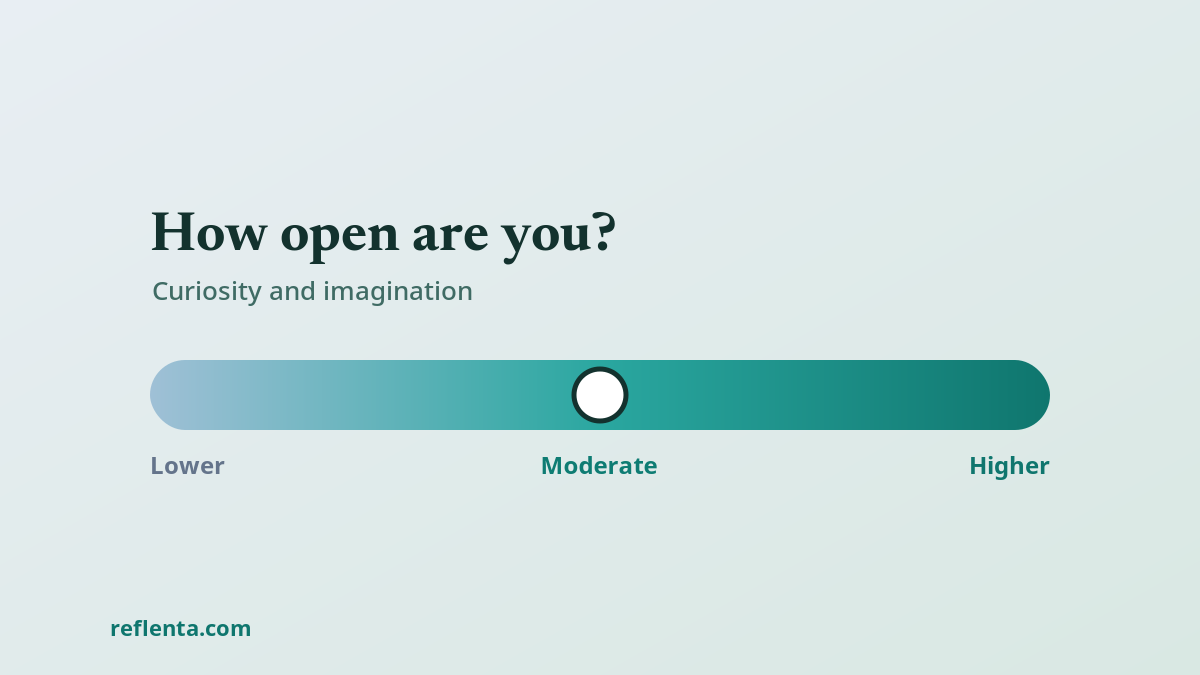
Think of it as a spectrum. On one end, you have people who thrive on abstract ideas and variety. On the other, you have people who find comfort in the concrete and the known. Both positions are normal. Neither is a defect. It is simply how your mind prefers to process the world.
If you have ever wondered how open-minded you are, this trait is the primary measure. It covers your interest in art, your willingness to try new foods, and your comfort with changing plans. You can take a free openness test to see where you land on this continuum.
The High End: Curiosity and Creativity
People high in openness enjoy novelty, abstract ideas, creativity, and variety. They often feel a pull toward the unknown. This group tends to question how things are done. They might rearrange their furniture just to see how it feels, or read a book on a topic they know nothing about.
This trait supports creativity and learning. High openness is linked to artistic expression and intellectual exploration. You might find yourself daydreaming more often or feeling restless when stuck in a rigid routine. This is not a distraction; it is a drive for new input.
However, high openness can sometimes feel like having too many tabs open in your browser. You might start five projects and finish none, or feel overwhelmed by too many choices. This is a common trade-off. The same trait that makes you creative also makes you sensitive to new stimuli.
The Lower End: Grounded and Practical
People lower in openness prefer the familiar, practical, and concrete. They value tradition and routine. While high openness seeks the new, lower openness seeks the reliable. This group is often described as grounded and down-to-earth.
This trait supports focus, consistency, and a practical approach. If you prefer a well-worn path over a trail through the woods, you likely score lower on this scale. You might find deep satisfaction in mastering a familiar skill rather than constantly learning a new one. There is no lack of imagination here; it is just directed differently.
Lower openness often correlates with reliability. People in this band are often the ones who remember birthdays, keep the house tidy, and stick to the plan. They provide stability in a changing world. Their preference for the concrete helps them execute ideas rather than just generating them.
Understanding Your Score Bands
Your score on a standard assessment places you in one of three bands. A score of 10 to 23 indicates lower openness. A score of 24 to 36 suggests moderate openness. A score of 37 to 50 reflects higher openness. A higher total means more curiosity and imagination, but it does not mean you are “better.”
Most people fall in the moderate range. This is the sweet spot where you can appreciate novelty but still value routine. If you scored low, you are not closed-minded. You are just more selective about what new things you let in. If you scored high, you are not scattered. You are just more receptive to new inputs.
Knowing your band helps you understand your reactions. If you feel bored at a family reunion, it might be your high openness craving variety. If you feel anxious at a surprise party, it might be your lower openness preferring the known. Neither reaction is wrong.
What Your Result Means for You
Openness to experience is a normal personality trait on a continuum. It is not a diagnosis. It does not predict your success or happiness. High openness supports creativity and learning, while lower openness supports focus and practicality. Both are valuable.
Understanding your position helps you build a life that fits your mind. If you are high, seek environments that allow exploration. If you are low, seek structure and clear expectations. You can explore this further by taking a free openness test to get a precise number.
Remember, the goal is not to change your trait but to understand it. Use your natural inclinations to your advantage. Whether you are an abstract thinker or a concrete doer, your way of seeing the world is valid and useful.